
The thyroid gland is a small, butterfly-shaped endocrine gland located in front of the breathing airway in the neck, and produces hormones that affect the body's metabolism and energy levels. "Thyroid hormones influence virtually every organ system. They tell organs how fast or slow they should work, and also regulate the consumption of oxygen and production of heat. Another gland, called the pituitary gland, controls how well the thyroid works. The pituitary gland is located at the base of the brain and produces Thyroid-Stimulating Hormone (TSH). Sometimes, solid or fluid-filled lumps are found in the thyroid. These nodules are fairly common and usually harmless. However, about 4 per cent of nodules are cancerous, so further testing is prescribed.
Thyroid gland regulates organs functions by manufacturing and secreting into the blood, a hormone called thyroxine. All organs of the body need to function at an optimum rate that is in sync with the rest of the body for proper balance in our metabolism. The role of the thyroid hormone is exactly this — to provide enough stimulus to the organs to function properly. An excess of the hormone is equivalent to unnecessarily "whipping" the organ to function excessively, even to the point of self destruction and a lack or decreased quantities of thyroxine cause the organs to work sluggishly. A person with a decreased level of thyroxine will be constipated because his intestines are not working hard enough.
In most cases, thyroid disorders are 'autoimmune' where the immune system creates antibodies against a normal part of the body. Thyroid antibodies attack the thyroid, causing changes in the function. The thyroid may be damaged by some antibodies so that it no longer produces enough thyroid hormone. This leads to hypothyroidism and is known as Hashimoto's thyroiditis. Other thyroid antibodies stimulate the thyroid to produce too much thyroid hormone, resulting in an overactive thyroid. This is called Graves' disease. The third type of disorder involves just an increase in the size of the gland without an alteration in thyroxine production. This leads to appearance of an unsightly swelling in the front of the neck, called goitre.
Symptoms of Thyroid
The thyroid can in disease produce more (hyperthyroidism) or less (hypothyroidism) hormone than normal.
- In hyperthyroidism, there is faster heart rate, tremors of the hands, intolerance to heat, diarrhoea, nervousness, sleeplessness, fatigue, weight loss and muscle weakness. In many cases, eyeballs tend to protrude out. Periods can became scanty or absent.
- In hypothyroidism, there is weakness, weight gain, dry hair, rough skin, swelling, constipation, depression, memory loss, decreased libido and abnormal periods often with excessive bleeding.
Hypothyroidism is treated by supplementation of the thyroid hormone in the form of pills, which is usually lifelong, with periodic monitoring. Iodine deficiency must also be looked into and iodised table salt encouraged. "Hyperthyroidism can be treated by three modalities of treatment — surgery, drug therapy and radioactive iodine treatment. Your physician will determine the best treatment for you. Goitres (Enlarged thyroids), even when the gland is functioning properly may need to be operated surgically because it is a cosmetic problem and in most of the cases will continue to grow in size. In girls near puberty and in pregnant women, the thyroid gland may get enlarged mildly even though it functions normally. This is because at these times there is more demand on the body's metabolism and the gland has to work extra.
Factors responsible for ThyroidCommon lifestyle factors can trigger autoimmune response in thyroid patients. These are stress, cigarette smoking, excess dietary iodine, trauma, artificial sweeteners that contain aspartame, sex steroids, which consist of estrogen and testosterone. While stress cannot be totally eliminated, it can be reduced with the help of yoga, meditation and light exercise.
What is Thyroid Removal Surgery (Thyroidectomy) ?
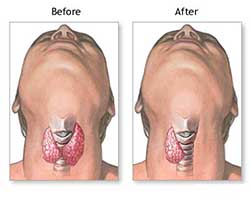 Thyroidectomy is the removal of all or part of the thyroid gland.
Thyroidectomy is done for the treatment of thyroid disorders, such as cancer, noncancerous enlargement of the thyroid (goiter) and overactive thyroid (hyperthyroidism).
How much of the thyroid gland is removed during thyroidectomy depends on the reason for surgery. If only a portion is removed (partial thyroidectomy), the thyroid may be able to function normally after surgery. If the entire thyroid gland is removed (total thyroidectomy), one would need thyroid hormone in the form of medicines to replace thyroid's natural function.
A thyroidectomy is recommended for conditions such as:
 Thyroid cancer. Cancer is the most common reason for thyroidectomy.
- Noncancerous enlargement of the thyroid (goiter). Removing all or part of thyroid gland is an option for the treatment of goiter that is uncomfortable or causes difficulty breathing or swallowing, or in some cases, if the goiter is causing hyperthyroidism.
- Overactive thyroid (hyperthyroidism). Hyperthyroidism is a condition in which the thyroid gland produces too much of the hormone thyroxine.
Procedure for Thyroidectomy
Thyroidectomy is done under general anesthesia and takes several hours. The surgeon makes a small incision in the front of your neck or a series of incisions under your arm, depending on the surgical technique being used. All or part of the thyroid gland is then removed, depending on the reason for the surgery. Conventional Thyroidectomy involves making an incision in the center of neck to directly access thyroid gland. Endoscopic Thyroidectomy uses smaller incisions in the neck. Surgical instruments and a small video camera are inserted through the incisions. Minimally Invasive or Endoscopic Thyroidectomy is done using special instrumentation and techniques, part or all of the thyroid gland can be removed through small puncture sites in the underarm area, avoiding any incision on the neck whatsoever. Much less pain and much more rapid recovery can be expected with this approach. Dr. Soumitra operates using laparoscopic instruments and supervises the case through endoscope cameras under high magnification. In many cases, the surgeon can see better in this technique than in a conventional open procedure. Only selected patients are suitable for this operative approach. Partial Thyroidectomy takes somewhere around 45 minutes to an hour and Total Thyroidectomy may take an hour and a half or two hours.
Before the operationPrior to any surgery, Doctor Soumitra will give you a complete medical examination and evaluate your overall health and your health history. You may be required to get additional tests such as X-rays and lab tests. Doctor will also review with you the potential risks and benefits of the operation and will ask you to sign a consent form. It is important that you ask questions and be sure you understand the reason for the surgery as well as the risks. It is important that you inform your doctor if you have allergies to any medications, what medications you are taking, and if you have bleeding problems. It is also important to inform your doctor if you are pregnant. Doctor Soumitra will also give you specific instructions on how to prepare for surgery, including guidelines on eating and drinking, smoking, taking or avoiding certain vitamins and medications. Carefully following these instructions will help your surgery go more smoothly.
After the operationIn Hospital
- Clean the wound with hydrogen peroxide using a cotton swab twice each day.
- Apply antibiotic ointment (bacitracin or polysporin) to the wound.
- If you have a bulb type drain, empty the drain bulb twice each day and record the output.
- The skin around the incision will be numb for several months after surgery.
- Three weeks after surgery, you may begin to massage the wound using a vitamin E or aloe containing lotion or oil. This will soften the scar over time.
- The sutures or the metal clips are removed three to seven days after the operation. Once the sutures are out, you may wash the wound with mild soap and water and gently dry the area.
At Home
- You are likely to feel very tired and need to rest two to three times a day for a week or more. You will gradually improve so that after about a month you will be able to return completely to your usual level of activity. You can drive as soon as you can make an emergency stop without hurting your neck, i.e. after about two weeks. You can restart sexual relations within two to three weeks when the wound is comfortable enough. You should be able to return to a light job after about two weeks and any heavy job within four to six weeks.
What are Benefits of Thyroidectomy Surgery?
Surgery is excellent therapy for hyperthyroidism with hardly any complications or recurrences. It is a great relieve for those not able to conceive and renders childbearing possible. Thyroidectomy also helps in avoiding long-term side-effects of antithyroid medications. Advanced technology and modern methods of treatment have decreased risks greatly and improved results of thyroidectomy. The new minimally invasive video-assisted thyroidectomy has several advantages over the current standard treatment which include smaller incisions that allows patient to heal faster. This helps patient to return to their normal lives sooner.
What are Side- effects of Thyroidectomy Surgery?- Symptoms of hypoparathyroidism, which include tingling and spasms of the extremities
- Fever
- Redness or swelling around the incision
- Warm incision
- Drainage from the incision


