

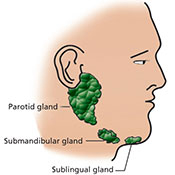
Salivary glands are glands found in and around the mouth and throat. They secrete saliva into the mouth through tubes called salivary ducts. There are 3 major salivary glands- the parotid, submandibular and sublingual glands.
Besides these, there are 600-1000 tiny glands called minor salivary glands located in the lips, inner cheek area (buccal mucosa), and linings of the mouth and throat. Salivary glands produce saliva that moistens the mouth, acts as a lubricant for speech, helps in swallowing, initiates digestion, has antibacterial properties and protects teeth from decay.
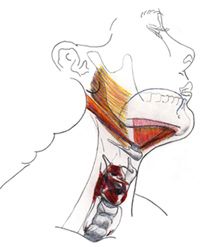
Types of Salivary Glands
 There are three major pairs of salivary glands:
- Parotid glands
- Submandibular glands
- Sublingual glands
Other minor Salivary Glands are as follows :
-
There are three major pairs of salivary glands:
- Glossopalatine glands
- Palatine glands
- Lingual glands
Disorders of the salivary glands include
Hyperplasia or swelling of the salivary glands:Rarely, the minor salivary glands may be swollen. They are seen as mild, painless masses usually on the roof of the mouth and soft palate. A biopsy is needed to be done to rule out other diseases. Once diagnosed, these swellings may subside on their own.
Salivary stones or calculi in the gland causing obstruction to the saliva flowSialoliths or salivary gland stones may be formed in the salivary glands or ducts. These cause obstruction to the flow of saliva. Patients complain of periodic painful swelling, typically when eating. The salivary glands swell then gradually subside after eating. If not treated early, infections or abscesses may occur.
Sometimes the salivary ducts may have small constrictions, which decrease salivary flow, leading to infection (sialadenitis) and obstructive symptoms.
Infections in the salivary gland may be viral, most commonly mumps, or bacterial. Most bacterial infections occur due to obstruction of salivary flow. Secondary infections of salivary glands from nearby lymph nodes may also occur. The affected gland gets swollen and painful accompanied with fever and difficulty in opening the mouth. Treatment includes antibiotic therapy and surgical drainage of the infection in case of abscess.
Trauma to the duct causing its rupture
Sometimes due to injury, the salivary gland duct may rupture leading to spillage of mucin into the surrounding soft tissues. This leads to the formation of mucocele or small dome-shaped swellings. These are very commonly seen on the lower lip or cheek. When they occur on the floor of the mouth, they are called ranula (retention cyst).
Under-functioning of the salivary gland causing dry mouth or xerostomiaDry mouth may be due to various causes like improper development or functioning of the salivary glands, excess water loss from the body, as a side effect of some medications or radiation therapy to the head and neck, diseases like Sjögren's syndrome, Diabetes or dry mouth may also occur due to local factors like smoking and mouth breathing. To cure the mouth dryness, first the underlying cause must be treated. Salivary substitutes may be used, or sugarless candy or gum can help keep the mouth moist. Good oral hygiene should be maintained to prevent mouth infections.
Salivary gland tumorsBenign or malignant tumors of the salivary glands may occur as growth or enlargements in the roof or floor of the mouth, cheek or lip. One or more glands may be involved. Any pain or loss of function of the affected region should be immediately investigated.
Autoimmune diseases like Sjögren's SyndromeIn some autoimmune diseases like HIV and Sjögren's syndrome, the salivary glands may be inflamed. Along with dry mouth (xerostomia) there may also be painful and burning sensation and dryness of the eyes. Secretory glands of the nose and throat may also be involved. Treatment is mostly supportive. Tear and saliva substitutes may be used to prevent dryness. Increased risk of tooth decay and fungal infections should be managed with preventive care.
Symptoms of Salivary Glands DiseasesWhen there is a problem with the salivary glands or ducts, one may experience symptoms such as salivary gland swelling, fever, and foul-tasting drainage into the mouth. There are other symptoms are as follows :
- Abnormal tastes, foul tastes
- Decreased ability to open the mouth
- Discomfort when opening the mouth
- Dry mouth
- Pain in the face or mouth pain
- Swelling in front of the ears
- Swelling of the face or neck
-
The salivary glands can be squeezed and the ducts observed for saliva flow.
- To diagnose other causes of swelling, a dentist or doctor may perform a biopsy to obtain a sample of salivary gland tissue and examine it under a microscope.
- If a salivary duct is blocked by a stone, a dentist may sometimes push the stone out by pressing on both sides of the duct. If that fails, a fine-wire-like instrument can be used to pull out the stone. As a last resort, the stone can be removed surgically.
Treatment and Surgery of salivary gland diseases
Treatment of salivary diseases includes medical and surgical modalities. Type of treatment depends upon the nature of the disease. If it is due to underlying medical conditions, then that must be treated first.
Some salivary gland lesions require to be removed surgically. Salivary gland stones or sialoliths have to be surgically excised. If the stones are located within the duct, surgical approach through the mouth may be planned. If the stones are within the gland and if there are severe changes in the duct structure, then the gland may be surgically removed extraorally.
In case of abscess, surgical drainage of the pus with antibiotic therapy may be required.
If an abnormal growth or mass has developed within the salivary gland, removal of the mass may be recommended. During surgery, great care must be taken to avoid damage to the facial nerve. This is an extremely vital nerve of the face that is responsible for movements of the facial muscles including the mouth and eye.
Salivary gland tumors are treated by surgical removal. In the case of benign tumors, surgery with complete removal of tumor is the curative treatment and no other treatment (i.e. radiotherapy or chemotherapy) is needed. In cases where salivary gland tumors are cancerous, surgery is the most effective treatment. However, in some patients, radiation therapy is also recommended. The need for radiation therapy is determined by numerous factors including the exact kind of cancer and its grade, the size of tumor and the location of the tumor.
-
In most situations, the surgery is performed as inpatient or as an outpatient. An anesthesiologist will monitor you throughout the procedure.
- If the doctor has ordered preoperative laboratory studies, one should arrange to have these done several days in advance.
- Aspirin, Non-steroidal anti-inflammatory medications or any product containing aspirin should not be consumed within 10 days of the date of your surgery.
- You must not eat or drink anything 6 hour prior to the time of surgery.
- Smokers should make every effort to stop smoking, or at least reduce the number of cigarettes. This will help to improve the healing process and to reduce postoperative coughing and bleeding.
Post Operative Tips
- Routine follow-up care depends on the nature of the problem.
- One should avoid excessive talking, smiling, hard chewing, strenuous activities, lifting heavy objects, and bending over.
- Alcohol and tobacco should be avoided because they may prolong swelling and healing.
- If you must be in the sun you should consider wearing a hat. You may use your usual make-up anytime after surgery.
- In the hospital and after you go home you should go to bed and rest with your head elevated on 2-3 pillows. By keeping your head elevated above your heart, you can minimize edema and swelling.
- Avoid straining, if you are constipated, take a stool softener or a gentle laxative.
- It is best to eat a light, soft, and cool diet as tolerated once you have recovered fully from the anesthetic.
Symptoms after Salivary Gland Surgery
-
Your face or neck may be swollen and bruised after surgery in many instances.
- Numbness, slight swelling, tingling discoloration, bumpiness, hardness, crusting, tightness and a small amount of redness around the incisions are normal findings after surgery and should improve with time.
- All bandages are usually removed one to two days following surgery.
- Sutures are removed approximately 7 days after surgery.
Benefits of Salivary Gland Treatment and Surgery
Most salivary gland infections resolve spontaneously or are cured with treatment. Complications are not common, but they may occur. A salivary stone is usually a one-off event. After it is removed there are usually no further problems. Anyone who is contemplating surgery must weigh the potential risks and complications against the potential benefits of the surgery. Artificial salivas for xerostomia help moisten the oral mucosa, relieving the discomfort of dry mouth and facilitating speaking, chewing and swallowing.


