
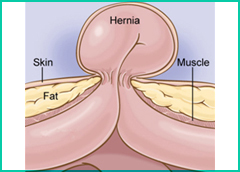
A hernia occurs when the inside layers of the abdominal wall weaken then bulge or tear. The inner lining of the abdomen pushes through the weakened area to form a balloon-like sac. This, in turn, can cause a loop of intestine or abdominal tissue to slip into the sac, causing severe pain and other potentially serious health problems.
The weakened abdominal wall can be present at birth or may develop later in life. The most common site is the groin, but hernias can also form in other areas, such as the navel. If the lump can be gently pushed back through the abdominal wall, it is known as a reducible hernia. If the lump resists manual pressure, it is a non-reducible hernia, which can mean serious complications.
What are the Symptoms of Hernias?
Most people with hernias have a common set of signs and symptoms. Some of the symptoms are as follows :
 An aching sensation on the abdomen or the groin that is more apparent when you are active, bending over or lifting things.
- An obvious swelling beneath the skin of the abdomen or groin that is visible while standing up.
- Most of the time the bulge can be pushed in or it goes back on its own when you lie down.
- If the hernia becomes extremely painful and hard then it may be incarcerated or trapped. This means that the fat or loop of intestine is now stuck in the hernia and is in danger of becoming gangrenous. This is referred to as strangulation. If you suspect that your hernia maybe incarcerated or trapped, then you should seek medical help immediately.
A hernia can occur anywhere in your abdomen (the part of your body between the chest and the hips). There are several types of hernia:
Inguinal Hernia -It occurs when part of the bowel pushes through the abdomen into the groin (the area at the front of the body where your thighs meet your abdomen). It is more common in men than in women. In this, the intestine or the bladder protrudes through the abdominal wall or into the inguinal canal in the groin. About 80% of hernias are inguinal hernia.
Femoral Hernia - It occurs when fatty tissues push through into the groin, at the top of the inner thigh and appear as a fixed lump. A femoral hernia occurs when the intestine enters the canal carrying the femoral artery into the upper thigh. Femoral hernias are most common in women, especially those who are pregnant or obese.
Incisional Hernia - It occurs when fatty tissue pushes through a surgical wound in the abdomen that has not fully healed. This type is most common in elderly or overweight people who are inactive after abdominal surgery.
Umbilical Hernia - It occurs when fatty tissue pushes through the abdomen near the navel or belly button. it appears as a round lump of fat pushing the belly button outward. This is one of the most common hernias. Common in newborns, it also commonly afflicts obese women or those who have had many children.
Hiatal Hernia - It occurs when part of your stomach pushes up into your chest by squeezing through an opening in the diaphragm.
Epigastric Hernia - It occurs when fatty tissue pushes through your abdomen, between your navel and the lower part of your sternum (breastbone).
Spigelian Hernia - It occurs when part of your bowel pushes through your abdomen at the side of your stomach muscle, below your navel.
Muscle Hernia -Muscle Hernia - It occurs when part of your muscle pushes through your abdomen and can also occur in the muscles in your leg, often as the result of a sports injury.
What are the Causes of Hernia?Usually, there is no obvious cause of a hernia. Sometimes hernias occur with heavy lifting. Hernias may be present at birth, but the bulging may not be noticeable until later in life. Some patients may have a family history of hernias.
Hernias can be seen in infants and children. This can happen when the lining around the abdominal organs does not close properly before birth. Some children may not have symptoms until they are adults.
Any activity or medical problem that increases pressure on the abdominal wall tissue and muscles may lead to a hernia, including Chronic constipation, straining to have bowel movements, Chronic cough, Cystic fibrosis, Enlarged prostate, straining to urinate, Heavy lifting, etc.
How is a Hernia Repaired (General Procedure) ?
There are several different procedures that can be used for fixing any specific type of hernia. In the open surgical approach, following appropriate anesthesia and sterilization of the surgical site, an incision is made over the area of the hernia and carried down carefully through the sequential tissue layers. This is to separate away all the normal tissue and define the margins of the hole or weakness. Once this has been achieved, the hole is then closed, usually by some combination of suture and a plastic mesh. When a repair is done by suture alone, the edges of the defect are pulled together, much like sewing a hole together in a piece of cloth. In order to provide a secure repair and avoid the stress on the adjacent tissue caused by pulling the hole closed, an alternative technique was developed which bridges the hole or weakness with a piece of plastic-like mesh or screen material. The mesh is a permanent material and, when sewn to the margins of the defect, it allows the body's normal healing process to incorporate it into the local structures. After the hernia repair is completed, the overlying tissues and skin are surgically closed, usually with absorbable sutures. More and more of hernia repairs are now being done using laparoscopic techniques.
What are the Different Types of Hernia Repair Surgery Procedure?There are different types of procedures depending on the type of hernia.
Inguinal Hernia RepairThere are two surgical methods for inguinal hernia repair –
- Open Technique - The most traditional and still the most common technique is to make an incision over the bulge and isolate the hernia. Hernia repair through mesh has become a common technique. In children, young adults, and most women, mesh is not used in the repair. In these patients a strong repair can be achieved with stitches alone.
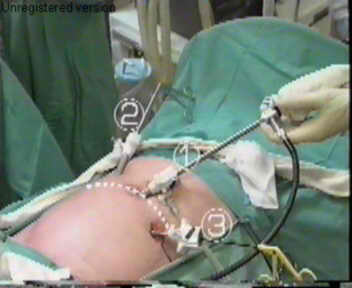
- Laparoscopic Technique - Laparoscopic hernia repair is similar to other laparoscopic procedures. General anesthesia is given, and a small cut (incision) is made in or just below the navel. The abdomen is inflated with air so that the surgeon can see the abdominal organs.
A thin, lighted scope called a laparoscope is inserted through the incision. The instruments to repair the hernia are inserted through other small incisions in the lower abdomen. Mesh is then placed over the defect to reinforce the abdominal wall.
There are many things to consider when deciding if you should have inguinal hernia repair surgery, such as whether your hernia is incarcerated or strangulated and whether you have other conditions that need to be addressed before hernia repair surgery is appropriate. It is an excellent operation for patients who have hernias on both sides and hernias that have recurred following an open repair.
Laparoscopic hernia repair usually is not done on children. But a laparoscope may be used during open hernia repairs in children to explore the opposite groin for a hernia. This can be done by inserting the laparoscope into the side that is being operated on and looking at the opposite side. If a hernia is present, the surgeon can repair both sides during the same operation.
What to Expect After Surgery
Most people who have laparoscopic hernia repair surgery are able to go home the same day. Recovery time is about 1 to 2 weeks. Studies have found that people have less pain after laparoscopic hernia repair than after open hernia surgery.
Why It Is Done?
Surgical repair is recommended for inguinal hernias that are causing pain or other symptoms and for hernias that are incarcerated or strangulated. Surgery is always recommended for inguinal hernias in children.
Laparoscopic surgery repair may not be appropriate for people who : –- Have an incarcerated hernia.
- Cannot tolerate general anesthesia.
- Have bleeding disorders such as hemophilia or idiopathic thrombocytopenic purpura (ITP).
- Are taking medicines to prevent blood clotting (blood thinners or anticoagulants, such as warfarin).
- Have had many abdominal surgeries. Scar tissue may make the surgery harder to do through the laparoscope.
- Have severe lung diseases such as emphysema. The carbon dioxide used to inflate the abdomen may interfere with their breathing.
- Are pregnant.
- Are extremely obese.
How Well It Works How Well It Works
The chance of a hernia coming back after laparoscopic surgery ranges from 1 to 10 out of 100 surgeries done.
Laparoscopic surgery has the following advantages over open hernia repair : –- Some people may prefer laparoscopic hernia repair because it causes less pain and they are able to return to work more quickly than they would after open repair surgery.
- Repair of a recurrent hernia often is easier using laparoscopic techniques than using open surgery.
- It is possible to check for and repair a second hernia on the opposite side at the time of the operation.
- Because smaller incisions are used, laparoscopy may be more appealing for cosmetic reasons.
Risks
Some people may need special preparation before surgery to decrease the risk of complications. These are people who : –
- Have a history of blood clots in large blood vessels (deep vein thrombosis).
- Smoke.
- Take large doses of aspirin. Aspirin slows blood clotting and may increase the chances of bleeding after surgery.
- Take blood thinners (such as warfarin, heparin, and enoxaparin).
- Have severe urinary problems, such as those caused by an enlarged prostate gland.
Doctors and researchers of laparoscopic hernia repair say that laparoscopy has not yet been proved to offer long-term advantages over open surgery. They stress on the need for more studies on laparoscopic safety and effectiveness in hernia repair.
Laparoscopic hernia repair is different from open surgery in the following ways : –- A laparoscopic repair requires several small incisions instead of a single larger cut.
- If hernias are on both sides, both hernias can be repaired at the same time without the need for a second large incision. Laparoscopic surgery allows the surgeon to examine both groin areas and all sites of hernias for defects. In addition, the patch or mesh can be placed over all possible areas of weakness, helping prevent a hernia from recurring in the same spot or developing in a different spot.
- Most of the time, a person must receive general anesthesia for laparoscopic repair. Open hernia repair can be done under general, spinal or local anesthesia.
Umbilical Hernia Repair - Usually under general anesthesia, an incision is made below the umbilicus and the hole is repaired with sutures alone or with mesh. Some bruising and swelling should be expected. Sometimes umbilical hernias can be repaired using laparoscopic technique that is done through small keyhole incisions, resulting in much less surgical trauma and postoperative pain.
Cisional Hernia Repair - The surgery to repair is done using general anesthetic and requires that the patient will be admitted to the hospital for up to five days. Mesh is usually part of the repair, and drains are placed in the wound for a few days to take away any fluid. As with most hernia operations, it takes about a month to get back to heavy physical work or exercise. A newer approach is using the laparoscopic technique. This leads to shorter hospital stay and a faster return to normal activity.
Epigastric Hernia Repair - Since the defects of epigastric hernias cannot be seen from inside the abdominal cavity, they need to be repaired in an open operation (rather than laparoscopically). Surgery involves repair of the area of weakness and return of the abdominal contents back into their normal position. If the hole in the muscle is less than 2cm it is stitched however usually a mesh is used to reinforce the area. Often small to moderate Epigastric Hernia repair can be performed under local anaesthetic.
Femoral Hernia Repair - A mesh, placed under local anaesthetic, avoids the need for cutting muscle or tendon, and eliminates high-tension stitching. This advanced technique is suited for repair of Femoral Hernias and usually allows for patient discharge on the same day, within hours of surgery.
Some hernias can be managed without an operation, particularly if they are painless. However, there is still a small risk of incarceration and care needs to be taken when performing heavy lifting. A hernia belt or truss can control the symptoms of an inguinal hernia allowing you to avoid or postpone surgery.
The amount of post-operative discomfort you will experience following surgery varies depending on the size of your hernia, type of repair and individual level of tolerance. Half the patients report they require no pain medication whatsoever. Activities can be resumed without restriction.
What are the Benefits of Hernia Repair Surgery?Developments in hernia surgery mean patients can enjoy rapid recovery with a very low risk of recurrence. Repair of the hernia eliminates pain and the risk of incarceration. Laparoscopic procedure results in less postoperative discomfort and pain, reduced recovery time that allows earlier return to full activity, easier repair of a recurrent hernia. It also decreases the incidence of recurrence.
Almost all hernia repairs are performed as an outpatient or might require a short overnight hospital stay. Most patients are discharged from the hospital the next day. Many doctors recommend surgery to repair hernia because it prevents strangulation. Hernia repair with mesh has proved to be a very effective means of repair.
As with any surgery, there are risks such as bleeding, infection, or an adverse reaction to anesthesia. Other risks include injury to the bowel or a recurrence of the hernia.


